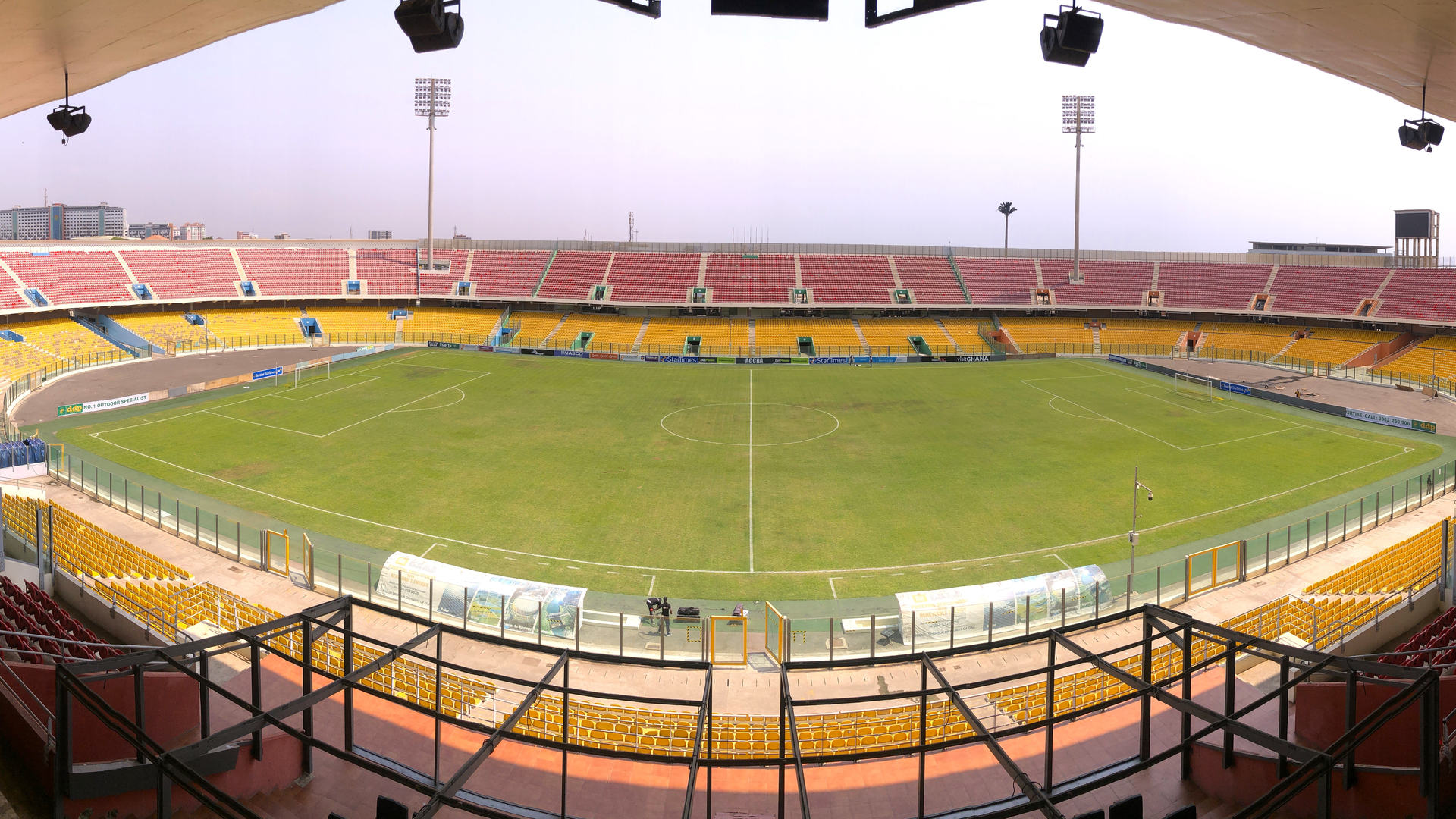
Asante Kotoko vs Hearts of Oak is the fixture that stops Ghana. On Super Clash weekend traffic thins in Kumasi and Accra as fans travel, taxis refuse fares in the wrong colours, and WhatsApp group names change to display flags. It is the oldest continuously running derby in West Africa, first played in 1958, and has grown into a rivalry where football is only the surface.
The deeper layer is geography and identity. Kotoko is the pride of the Ashanti Kingdom, Kumasi-based, red-and-white, backed publicly by the Asantehene. Hearts is the club of coastal Accra, Ga-speaking, purple and yellow, backed historically by the Ga Mantse and waves of political support. When these sides meet, the stadium chants include lines that have nothing to do with football.
All-time record across GPL, Ghana FA Cup, Super Cup, President's Cup, and friendlies (per Ghana FA records through the 120th-meeting preview in 2026). Kotoko hold a narrow edge on wins.
LEGENDARY SCORERS
The heroes who defined the derby across generations.
A memorable Super Clash during Hearts' 2000 CAF Champions League-winning era. Accra Sports Stadium sold out.
2021 · 2021–22 TITLE RUN KICK-OFF
Kotoko 3–1 Hearts
One of the early Super Clashes played in front of fans post-COVID. Kotoko went on to win the GPL title that season.
Vibrance
VIBRANCE OF GHANA
Super Clash weekend has its own liturgy. Kotoko fans wear red, chant 'Kum apem a, apem beba' (kill a thousand, a thousand more will come), and treat the Asantehene's public blessing as the true kick-off. The Porcupine Warriors' tifos unfurl 20 minutes before kick-off, usually in the Home End of Baba Yara.
Hearts' fans, the Phobians, wear purple and yellow and carry the Gye Nyame Adinkra symbol onto matchday. Their chants lean older and longer; their oldest ultra group, 747, named itself after the Boeing jumbo jet because 'Hearts take you everywhere'. Both sides observe an informal rule: no matter who wins, the post-match chant is still 'Yɛte no pa', 'we say it well.'
music_note
Derby Chants & Traditions
local_fire_department
Red Sea
When Kotoko score at Baba Yara, the Home End lights flares and fans chant the name of the goalscorer for 3 full minutes. Opposition fans stay quiet.
church
Asantehene's blessing
For marquee Super Clashes in Kumasi, Kotoko players visit the Manhyia Palace 48 hours before kick-off. The visit is televised on local channels.
music_note
747 Chant
Hearts' ultras chant their plane-name anthem before kickoff, during halftime, and after the final whistle regardless of result.
volunteer_activism
Tifo Exchange
For titles or milestones, each set of fans unveils a surprise tifo. The 2021 Kotoko 'Porcupine + Adinkra' display is regarded as the best in GPL history.
warning
Safety & Logistics
Wear neutral colours if you're travelling between cities on Super Clash day. Taxi drivers and intercity buses are vigilant about the wrong colours in the wrong city.
Avoid the Home End blocks if you're an away fan. Segregation is enforced at both Baba Yara and Accra Sports Stadium, separate Gate D for away supporters.
The Ghana Police Service deploys 800+ officers at Super Clashes in Kumasi, 600+ in Accra. Comply with any direction; the history of crowd incidents has made the police cautious.
In Kumasi: avoid the Kejetia central market 2 hours before and after kickoff. In Accra: the Osu area is lively but safer than Nima or La before/after the match.
Keep phone and cash separate. Both Baba Yara and Accra Sports have a documented pickpocket problem at turnstile crushes.
Red Cross + Ghana Ambulance Service at every Super Clash. On-site trauma clinic at each stadium. Free for emergency cases.
Expect 2–3× normal GPL pricing on Super Clash day. Standard home-end seats cost GHS 40 for an ordinary GPL fixture but GHS 100–150 for Kotoko vs Hearts. VIP boxes at Baba Yara sell out 6–8 weeks in advance.
warning
Do not buy from scalpers at Kejetia (Kumasi) or the Trust Hospital area (Accra). Counterfeit tickets for Super Clash are a known problem, they clone the QR pattern but fail at the gate. Only use GFA portal, club sites, or Ticketmaster Ghana.
The Super Clash is the Asante Kotoko vs Hearts of Oak football fixture, Ghana's most intense domestic derby. First played in 1958, the rivalry is defined by Kumasi vs Accra geography, Ashanti vs Ga cultural identity, and 60+ years of title-deciding matches. Kotoko hold a narrow edge in the all-time head-to-head.
When was the Super Clash first played?
1958. The two clubs have met roughly 119 times across league, cup, Super Cup, President's Cup and friendly competitions through the 2025–26 GPL season.
2025-26 Super Clash fixtures, Kotoko 1-0 in Accra, Hearts 1-0 at Baba Yara
The 2025-26 Ghana Premier League Super Clash split 1-1 across the two legs. Kotoko won the first at Accra Sports Stadium on 9 November 2025 with a debut Morifing Donzo penalty, then Hearts of Oak responded at Baba Yara on 16 February 2026 with a Baba Adamu header, ending a 175-day Kotoko unbeaten run while playing the final hour with ten men.
First leg, 9 November 2025, Accra Sports Stadium. Morifing Donzo, on his Kotoko debut, scored the only goal of the match from the penalty spot for a 1-0 Kotoko win. The result kept Kotoko's then-unbeaten streak in the fixture intact and added to a four-in-five league-meeting lead Kotoko had built up against Hearts.
Second leg, 16 February 2026, Baba Yara Stadium. Hearts of Oak won 1-0 with a 15th-minute Baba Adamu looping header that caught Kotoko goalkeeper Mohammed Camara off his line. Emmanuel Amankwah was sent off for a second-yellow challenge inside the first half-hour. Hearts defended the 1-0 lead with ten men through a sustained Kotoko siege, the kind of performance the club's "Never Say Die" motto repeatedly returns to. Kotoko coach Prince Yaw Owusu publicly attributed the defeat to the goalkeeping mistake in a post-match press call, per adomonline.com.
The 175-day streak that ended dated from the previous head-to-head Hearts loss. Citi Sports Online's match report described the win as Hearts of Oak's first away result against Kotoko at Baba Yara in the Super Clash since 2008. Hearts moved into third place on the league table with 39 points; Kotoko sat fifth on 35 points, nine behind league leaders Medeama SC.
All-time head-to-head, 119 meetings since 1958
The Super Clash has been played around 119 times across Ghana Premier League, FA Cup, Super Cup, President's Cup and friendly fixtures since the first meeting in 1958. Asante Kotoko hold a narrow all-time lead, roughly 41 wins to Hearts of Oak's 38, with 40 draws across the 119 fixtures, per the project's headline data block.
Both clubs are the dominant institutions in their respective regions and combined account for the vast majority of Ghana's domestic league titles. Kotoko's Wikipedia honours table records 25 Ghana Premier League titles (the article opener says 24, the GPL overview says 26) and 9 FA Cups; Hearts of Oak record 21 GPL titles and 12 FA Cups. The combined trophy haul makes the fixture the highest-stakes single match-up in Ghanaian club football.
Continental finals are the higher tier. Kotoko reached the CAF Champions League final in 1967, 1971, 1973, 1982 and won twice (1970, 1983). Hearts of Oak won the 2000 CAF Champions League and the 2001 CAF Super Cup. Africa's continental honour list is one Kotoko-vs-Hearts story across the same generation.
Recent league head-to-heads have favoured Kotoko by margin (four wins in five meetings prior to the 16 February 2026 Hearts win). The 2025-26 split of one-each leaves the multi-season league record more balanced, though the all-time head-to-head edge stays with Kotoko.
Top scorers in the fixture's history
Reliable fixture-specific goal counts are not exhaustively documented across the 67-year head-to-head. Among the fixture's best-remembered scorers, three names recur in Ghanaian football's collective memory: Opoku Afriyie, Mohammed Polo, and Ishmael Addo.
Opoku Afriyie (Asante Kotoko, 1970s-80s) was Ghana's 1978 AFCON winner with a brace in the final and was the GPL's top scorer in 1979 and 1981. Late in his career he moved to Hearts of Oak, the rare crossover that has happened only a handful of times in the rivalry's history. He remains the most-cited single name in any "who scored most in the Super Clash" conversation.
Mohammed Polo (Hearts of Oak, three spells 1973-92) was the left winger of the late-Phobian generation. His first Hearts spell produced 145 goals in 232 appearances. Two further spells, the third extending into the early 1990s, made him the longest-serving Hearts senior of any era. The Super Clash goals he scored were typically from outside the box and from set-piece deliveries.
Ishmael Addo (Hearts, 1999-2002 and 2006-08) anchored the 1999-2003 Hearts side that won the CAF Champions League and the dominant domestic period that followed. 103 league goals across both spells; GPL top scorer in his breakout 1999-2000 season with 22 league goals. His Super Clash record is widely cited but not officially aggregated by either club.
Cultural fault line, Asante kingdom vs Ga coastal identity
The Super Clash maps onto the Kumasi-Asante / Accra-Ga cultural fault line that runs through Ghanaian identity. Kotoko is the pride of the Ashanti Kingdom, life-patronised by the Asantehene Otumfuo Osei Tutu II. Hearts of Oak is the institutional club of coastal Accra, historically backed by the Ga Mantse and waves of political support.
The political-party alignment is half-explicit. Kotoko's Ashanti base correlates broadly with NPP (New Patriotic Party) territory; Hearts' Greater Accra base aligns more closely with NDC (National Democratic Congress) bastions. Election-cycle conversations on Ghanaian sports radio routinely reference the Kotoko-Hearts axis when discussing wider political identity, even when no direct policy overlap exists.
The languages on display in the stadium are different. The Baba Yara crowd's chants are in Twi (the Asante dialect); the Accra Sports Stadium crowd uses Ga and Ewe alongside Twi. The Asantehene's patronage is publicly visible at Kotoko home games; the Ga Mantse's role at Hearts is less institutionally codified but historically central. The 1958 fixture that started the rivalry was as much a meeting of two cultural identities as of two football clubs.
Match-day travel between Kumasi and Accra on Super Clash weekend has its own folklore. Taxis on the Kumasi-Accra route refuse fares from passengers wearing the wrong colours; WhatsApp group names switch to flags; chiefs in both regions issue private statements ahead of the fixture. The cultural surround is the part of the Super Clash that no other African club derby fully replicates, the Soweto Derby has bigger stadium attendance, but the Super Clash has the deeper political-cultural fabric.
Where to watch and tickets
GHOne TV (free-to-air Ghana), GTV Sports+ (state broadcaster), StarTimes Sports Africa-wide, and SuperSport for selected fixtures cover the Super Clash live. The GFA YouTube channel uploads highlights within 24 hours. Ticket prices for the fixture run 2-3x normal GPL pricing.
Domestic broadcast in Ghana is shared across GTV Sports+ (the state broadcaster, free-to-air) and the privately owned GHOne TV (also free-to-air on terrestrial frequencies). Africa-wide coverage runs through StarTimes' Sports Africa subscription channel and SuperSport's selected pickup, the latter typically cherry-picking the higher-profile leg of the season's two fixtures. SuperSport USA carries the match for the United States diaspora when the fixture overlaps with the broadcaster's Saturday-Sunday schedule.
Tickets for the home leg run GHS 100-150 for standard general entry, GHS 300-400 for VIP and corporate hospitality boxes, with a GHS 40 normal-fixture price that doubles or triples for the Super Clash itself. The official ticket portals are ghanafa.org/tickets (GFA-administered for selected fixtures), the clubs' own websites (scasantekotoko.com, heartsofoakgh.com), and Ticketmaster Ghana for selected matches. Buying from scalpers at the gate is widespread and not recommended.
Matchday safety: 600-800 Ghana Police officers per fixture, segregated entry through Gate D at both stadiums, and a Red Cross / Ghana Ambulance medical service on-ground. Travelling fans are advised to wear neutral colours on the Kumasi-Accra route. Pickpocketing at the turnstile crush is the most common security incident; phone and cash should be kept separate.
Frequently Asked Questions
What is the Super Clash?
The Super Clash is the Asante Kotoko vs Hearts of Oak football fixture, Ghana's most intense domestic derby. First played in 1958, the rivalry is defined by Kumasi vs Accra geography, Ashanti vs Ga cultural identity, and 60+ years of title-deciding matches. Kotoko hold a narrow edge in the all-time head-to-head.
When was the Super Clash first played?
1958. The two clubs have met roughly 119 times across league, cup, Super Cup, President's Cup and friendly competitions through the 2025–26 GPL season.
Who has won the Super Clash more times?
Asante Kotoko hold a narrow all-time head-to-head lead, roughly 41 wins to Hearts of Oak's 38, with 40 draws across ~119 meetings (per Ghana FA's preview data ahead of the 120th Super Clash).
Where is the Super Clash played?
It alternates between Baba Yara Stadium in Kumasi (Kotoko's home, 40,528 capacity) and Accra Sports Stadium (Hearts' home, 40,000 capacity). Each season one match is at Baba Yara and one at Accra. Away-end tickets are segregated with separate entry through Gate D at both grounds.
How much does a Super Clash ticket cost?
Super Clash tickets are 2–3× normal GPL pricing. Standard home-end seats cost GHS 100–150 for a Super Clash (vs GHS 40 for a normal fixture). VIP boxes run GHS 300–400 and sell out 6–8 weeks in advance. Buy through ghanafa.org/tickets, the clubs' official portals, or Ticketmaster Ghana, never from scalpers.
Who are the historic top scorers in the Super Clash?
Among the fixture's best remembered scorers: Opoku Afriyie (Asante Kotoko, 1970s–80s, Ghana's 1978 AFCON-winning brace), Mohammed Polo (Hearts of Oak, three spells 1973–92, 145 goals in his first Hearts stint), and Ishmael Addo (Hearts, 103 league goals across 1999–2002 and 2006–08). Fixture-specific goal counts are not reliably documented.
Why is the Super Clash so important?
Three reasons. One, football: Kotoko and Hearts together account for 38+ of Ghana's ~67 Premier League titles. Two, geography: Kumasi vs Accra is the Ashanti-vs-coastal axis of Ghanaian identity. Three, history: the 1993 and 2008 Super Clashes both decided the league title in the 90th minute of the final matchday, match-deciding moments that shaped a generation of fans.
Where can I watch the Super Clash live?
In Ghana: GTV Sports+, StarTimes Kumasi, and Max TV. Pan-Africa: SuperSport (DStv). Diaspora: Afrisport app, SuperSport USA for the United States, and the clubs' own live streams (scasantekotoko.com/live, heartsofoakgh.com). All Super Clashes since 2003 have been on SuperSport.
Is it safe to attend the Super Clash?
Yes, with precautions. The Ghana Police deploys 600–800 officers at each match and segregation is strictly enforced. Wear neutral colours if travelling between Kumasi and Accra on match-day. Pickpocketing at turnstile crushes is the most common issue, keep phone and cash separate. The stadium medical service includes Red Cross + Ghana Ambulance.
When is the next Super Clash?
The 2025-26 GPL second-leg Super Clash already played: Hearts of Oak won 1-0 at Baba Yara on 16 February 2026, ending a 175-day Kotoko unbeaten run. The next first-team meeting is the 2026-27 GPL fixture cycle, scheduled around the GFA-published season calendar in August 2026.
What was the latest Super Clash result?
Hearts of Oak 1-0 Asante Kotoko at Baba Yara Stadium, 16 February 2026. Baba Adamu scored a 15th-minute looping header. Hearts of Oak played the final hour with ten men after Emmanuel Amankwah was sent off for a second-yellow challenge. Goalkeeper Mohammed Camara was caught off his line for the goal. Hearts ended a 175-day Kotoko unbeaten run in the fixture.
Who scored in the 2025-26 Super Clash fixtures?
First leg, 9 November 2025 at Accra Sports Stadium: Morifing Donzo scored the only goal of a 1-0 Kotoko win on his debut, from the penalty spot. Second leg, 16 February 2026 at Baba Yara: Baba Adamu scored the only goal of a 1-0 Hearts win, a 15th-minute header. Two clean sheets, two 1-0 results, one each way.
Where can I watch the Super Clash live in 2026?
GHOne TV (free-to-air Ghana), GTV Sports+ (state broadcaster), StarTimes Sports Africa-wide subscription, and SuperSport for selected fixtures across DStv. Highlights live on the GFA YouTube channel within 24 hours. The clubs' own live streams (scasantekotoko.com/live, heartsofoakgh.com) cover diaspora viewers when broadcast rights permit.
Is the Super Clash bigger than the Soweto Derby?
By stadium attendance and broadcast viewership the Soweto Derby (Pirates vs Chiefs at FNB Stadium, 90,000+ capacity) is larger. By cultural depth the Super Clash is older (first played 1958 vs Soweto Derby 1970) and embeds tribal-political identity (Ashanti vs Ga, NPP vs NDC alignment) more directly. Both are widely cited among Africa's three or four biggest club fixtures.
Who is the all-time Super Clash top scorer?
Reliable fixture-specific goal counts are not exhaustively documented across the 67-year history. Among the fixture's best-remembered scorers: Opoku Afriyie (Asante Kotoko, 1970s-80s, Ghana's 1978 AFCON-winning brace), Mohammed Polo (Hearts of Oak, three spells 1973-92, 145 goals in his first Hearts stint), and Ishmael Addo (Hearts, 103 league goals across two spells).
You're about to visit the operator. Afroduma has no affiliate partnership with this brand — this is an independent editorial review. Please read their terms before signing up.
18+. Gamble responsibly. Betting and casino games carry real financial risk. Set deposit limits. If gambling stops being fun, contact your local helpline.